

4 Day Pacaya Samiria Birdwatching Adventure
Amazon Birds, Flooded Forests & Bird Identification Experience from Iquitos
Discover the extraordinary birdlife of the Peruvian Amazon on our 4 Day Pacaya Samiria Birdwatching Adventure, a specialized nature experience designed for travelers who love birds but do not need to be professional birders. Beginning in Iquitos and traveling toward the remarkable wetlands and flooded forests of the Pacaya Samiria National Reserve region, this journey introduces you to one of the richest bird habitats in the Peruvian Amazon.
Rather than simply creating a checklist of species, this Pacaya Samiria birdwatching tour is designed to help you understand what you are seeing. With the assistance of an experienced local nature guide, we explore rivers, lagoons, forest edges and rainforest trails while learning how to recognize birds through shape, size, colors, flight patterns, habitat, feeding behavior and vocalizations. From colorful macaws and toucans to kingfishers, herons, hoatzins and birds of prey, every excursion becomes an opportunity to understand the incredible diversity of Amazon birds in Peru.
Overview
Our 4 Day Pacaya Samiria Birdwatching Adventure from Iquitos has been created especially for bird lovers, nature enthusiasts, photographers and travelers who want to discover Amazon birdlife without requiring previous birdwatching experience.
The adventure begins in Iquitos, from where we travel toward the river systems associated with Pacaya Samiria and the vast wetlands of the Loreto region.
Over four days, our activities are organized around the periods when birds are generally most active.
This means early mornings and late afternoons are especially important.
Rather than sleeping through sunrise, we are often already on the river or walking quietly along the forest edge while the Amazon awakens.
We explore different habitats because different birds prefer different environments.
Open rivers may reveal terns, swallows and raptors.
Riverbanks and wetlands attract herons, egrets, kingfishers and jacanas.
Flooded forests provide habitat for hoatzins, woodpeckers, parrots and many other forest species.
High canopy and forest edges can reveal macaws, toucans and birds of prey.
Our guide also introduces you to the fundamentals of Amazon bird identification.
You will begin learning to ask useful questions:
How large is the bird?
What shape is its bill?
Is it alone, in a pair or moving with a flock?
Is it feeding near the water or high in the canopy?
Does it fly directly or move between branches?
What does its call sound like?
Understanding these details transforms birdwatching from simply seeing a colorful bird into understanding how that bird lives within the rainforest.
Other Amazon wildlife may naturally appear during our excursions, including pink river dolphins, monkeys, sloths, reptiles and caimans, but birds remain the principal focus of this journey.
- Tour: Pacaya Samiria Birdwatching Adventure
- Duration: 4 Days / 3 Nights
- Starting Point: Iquitos
- Ending Point: Iquitos
- Region: Loreto – Peruvian Amazon
- Main Focus: Amazon Birdwatching & Bird Identification
- Destination: Pacaya Samiria Amazon Region
- Tour Type: Birdwatching, Nature & Wildlife
- Birding Level: Beginner to Intermediate
- Physical Difficulty: Easy to Moderate
- Best For: Amateur Birdwatchers, Nature Lovers, Wildlife Photographers, Couples & Families.
Birdwatching Highlights
- Enjoy additional Amazon wildlife encounters along the way.
- Explore one of Peru’s richest Amazon birdwatching destinations
- Discover the birdlife of the Pacaya Samiria region
- Experience sunrise birdwatching
- Navigate flooded Amazon forest
- Explore rivers, lagoons and forest edges
- Learn fundamental bird identification techniques
- Learn to recognize birds by shape and size
- Understand different bill types
- Recognize feeding behaviors
- Learn how habitat helps identify species
- Begin recognizing Amazon bird calls
- Search for macaws and parrots
- Look for toucans and aracaris
- Observe kingfishers
- Search for herons and egrets
- Look for hoatzins
- Observe jacanas and aquatic birds
- Search the canopy for woodpeckers
- Look for Amazon raptors
- Observe mixed bird activity along forest edges
- Experience late-afternoon birdwatching
- Discover nocturnal and crepuscular bird activity
- Learn about resident and migratory Amazon birds
- Photograph birds in their natural habitats
Itinerary
Day 1: Iquitos – Amazon River System – Introduction To Amazon Birdwatching.
Welcome to the Amazon
Our 4 Day Pacaya Samiria Birdwatching Adventure begins with pick-up from your accommodation or airport in Iquitos.
After meeting your local nature guide, we begin traveling toward the Amazon environments that will become our outdoor classroom for the next four days.
From the beginning, our guide introduces us to the fundamentals of birdwatching in the rainforest.
Amazon birding is very different from observing birds in open environments.
Vegetation can be dense.
Birds may remain high in the canopy.
Many species are heard before they are seen.
For this reason, learning where to look and what to listen for becomes just as important as recognizing colors.
First Amazon Birdwatching Session
Once we reach our exploration area, we begin our first birdwatching excursion.
The objective today is not to chase rare species.
Instead, we begin becoming familiar with the different groups of birds commonly associated with Amazon rivers and forest edges.
Depending on habitat and natural activity, we may observe herons, egrets, kingfishers, jacanas, swallows, parrots and other tropical birds.
Our guide helps us notice important identification characteristics.
Learning to Observe
Rather than immediately telling us the name of every bird, our guide encourages us to observe.
What size is it?
What is the shape of the bill?
Where is it perched?
How does it move?
What is it eating?
These simple questions are the foundation of bird identification.
A kingfisher sitting above the water behaves very differently from a parrot feeding high in the canopy.
A heron standing motionless beside a lagoon occupies a completely different ecological niche from a swallow catching insects above the river.
By observing behavior, birdwatching becomes much more intuitive.
Late-Afternoon Bird Activity
Later in the afternoon, we return to the field.
As temperatures begin to decrease, bird activity often increases.
Parrots and macaws may move toward feeding or roosting areas.
Herons and other aquatic birds become active around the water.
Raptors may still be visible above the forest.
Our guide also begins introducing us to common Amazon bird vocalizations.
In dense rainforest, sound can sometimes be our first clue that a bird is nearby.
As daylight disappears, we return to our accommodation for dinner.
Our first day has introduced us not only to Amazon birds, but to a new way of looking at the rainforest.
- Meals: Lunch & Dinner
- Accommodation: Jungle Accommodation.
Day 2: Sunrise Birdwatching – Flooded Forest – Amazon Bird Identification.
The Amazon Dawn Chorus
We begin before sunrise.
For birdwatchers, this is one of the most exciting moments of the day.
As the first light reaches the rainforest, the silence gradually disappears.
Calls begin coming from different levels of the forest.
Some birds communicate from the canopy.
Others move along riverbanks.
Parrots may begin flying overhead.
The rainforest is waking up.
Sunrise Birdwatching
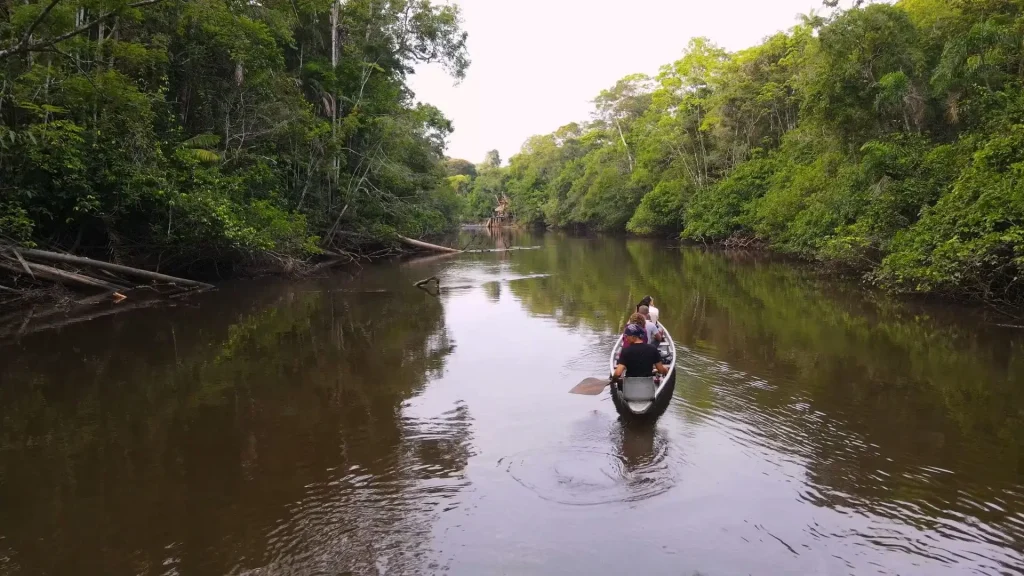
We quietly explore by boat or canoe, depending on local conditions.
Moving slowly on the water allows us to observe without creating unnecessary disturbance.
We search for kingfishers, herons, egrets, jacanas, parrots, macaws, woodpeckers and other Amazon birds.
The exact species will always depend on season, habitat and natural activity.
Our guide helps us distinguish between birds that may initially appear similar.
Bill shape, tail length, wing pattern and behavior can all provide important identification clues.
Flooded Forest Birding
After breakfast, we explore another important Amazon habitat: flooded forest.
Pacaya Samiria is famous for its enormous system of rivers, creeks, lagoons and seasonally inundated rainforest.
These aquatic environments create feeding and nesting opportunities for an extraordinary variety of birds.
We move slowly while watching branches above the water.
One of the most characteristic birds of these environments is the Hoatzin (Opisthocomus hoazin), an unusual tropical species often associated with vegetation near Amazon waterways.
Its crest, body shape and distinctive behavior make it one of the most recognizable birds of the Amazon.
Birds of the River
We also focus on species adapted to life around water.
Kingfishers may perch above the river before diving for fish.
Herons stand almost completely motionless while waiting for prey.
Jacanas walk across floating vegetation with their extraordinarily long toes.
Other aquatic and semi-aquatic species occupy different ecological niches around the wetlands.
Rather than simply identifying them, our guide explains why each bird is found where it is.
Forest Edge Birdwatching
Later in the afternoon, we explore forest edges and more open environments.
These transitional habitats can be particularly productive because they allow us to see birds moving between different forest layers.
We search for toucans, aracaris, parrots, woodpeckers and other canopy species.
Macaws may occasionally cross overhead in pairs or small groups, their calls often announcing their arrival before we see them.
As sunset approaches, we finish another full day of Amazon birding.
- Meals: Breakfast, Lunch & Dinner
- Accommodation: Jungle Accommodation.
Day 3: Macaws – Toucans – Raptors – Amazon Forest Birdwatching.
Another Early Start
By the third morning, the sounds of the rainforest may already feel more familiar.
Some calls that were completely unknown on Day 1 may now be recognizable.
This is exactly what this Amazon birdwatching tour for beginners and enthusiasts is designed to achieve.
We are not simply collecting names.
We are learning how to observe.
Parrots & Macaws
Our morning excursion focuses partly on searching for some of the Amazon’s most charismatic birds.
Parrots and macaws are highly mobile and their presence varies naturally from day to day.
We listen for their distinctive calls and watch for movement above the canopy.
Depending on location and natural activity, possibilities can include scarlet macaws, blue-and-yellow macaws and other parrots and parakeets.
Their powerful bills, strong flight and social behavior make parrots one of the most fascinating bird families to observe.
Toucans & Aracaris
We also search fruiting trees and canopy openings for toucans and aracaris.
Their enormous bills make these birds instantly recognizable, but locating them inside dense rainforest can still require patience.
Our guide watches for silhouettes and movement in the upper canopy while listening for vocalizations.
Birds of Prey
Raptors present a completely different birdwatching challenge.
Rather than focusing only inside the vegetation, we periodically scan the sky and exposed branches.
Different hawks and other birds of prey inhabit Amazon environments.
Large raptors also occur within the wider ecosystem, but encounters with uncommon species are always a matter of luck.
Jungle Trekkers Peru never guarantees rare bird sightings.
Understanding Amazon Bird Behavior
During today’s excursions, we begin connecting everything learned over the previous days.
Habitat.
Behavior.
Shape.
Vocalization.
Feeding strategy.
Flight pattern.
Instead of asking only:
“What bird is that?”
we begin asking:
“Why is that bird here?”
That question leads to a much deeper understanding of Amazon ecology.
Afternoon Birding
After lunch and some rest during the hottest part of the day, we return to the field.
Late afternoon gives us another opportunity to search for birds moving toward feeding and roosting areas.
Depending on activity, we may encounter macaws, parrots, toucans, kingfishers, herons, woodpeckers and other tropical species.
Dusk & Nocturnal Birds
As daylight fades, we remain attentive.
The bird community begins to change.
Daytime species become quieter while nocturnal birds begin their activity.
We listen carefully for nightjars, owls and other birds associated with darkness.
Seeing nocturnal species can be challenging, but hearing them is an important part of understanding Amazon birdlife.
After our exploration, we return for dinner.
- Meals: Breakfast, Lunch & Dinner
- Accommodation: Jungle Accommodation.
Day 4: Final Sunrise Birding – Bird Identification Review – Return To Iquitos.
One Last Dawn in the Amazon
Our final day begins early once again.
By now, you understand why birdwatchers are willing to wake before sunrise.
The forest is cooler.
Bird activity increases.
Calls come from multiple directions.
And every few minutes can bring something completely different.
We return to one of the most productive habitats identified during the previous days.
Putting Your New Skills into Practice
Today, our guide encourages you to take a more active role.
When a bird appears, instead of immediately identifying it for you, we begin working through the clues together.
- Size.
- Shape.
- Bill.
- Color pattern.
- Habitat.
- Behavior.
- Vocalization.
Perhaps you will recognize a kingfisher before your guide says anything.
Maybe the unusual shape of a hoatzin will now be obvious.
Or perhaps you will hear parrots approaching before they appear above the trees.
These small moments are what make an educational birdwatching journey rewarding.
Final Amazon Bird Search
We continue exploring through the morning, searching for species we may not yet have encountered.
Every day is different.
Some species seen during the first morning may disappear completely.
Others may suddenly appear for the first time on our final excursion.
That unpredictability is fundamental to genuine birdwatching.
After completing our final activity, we return for breakfast or lunch according to the day’s schedule and prepare for our journey back toward Iquitos.
Return to Iquitos
As we leave the rainforest behind, our guide can review some of the birds observed during the journey and discuss the different habitats we explored.
The goal of our 4 Day Pacaya Samiria Birdwatching Adventure is not simply to leave with photographs or a species list.
We hope you return to Iquitos with something more valuable:
the ability to look at birds differently.
You may arrive as a nature traveler.
You may leave as a birdwatcher.
- Meals: Breakfast & Lunch.
Included
Included
- Pre-tour briefing
- Pick-up from your accommodation or airport in Iquitos
- All required ground transportation
- River transportation for scheduled birdwatching excursions
- Professional local nature and birdwatching guide
- 3 nights jungle accommodation
- Meals indicated in the itinerary
- Drinking water during the program
- Entrance arrangements required for the scheduled itinerary
- Sunrise birdwatching excursions
- River birdwatching
- Flooded forest birdwatching
- Forest-edge birdwatching
- Guided rainforest walks
- Bird identification instruction
- Introduction to Amazon bird vocalizations
- Bird behavior interpretation
- Nocturnal bird search
- Additional wildlife observation
- Rubber boots when required by trail conditions
- Life jackets for river transportation
- First-aid kit
- Vegetarian and other dietary options with advance notice
- Return transfer to your hotel or airport in Iquitos according to your travel arrangements.
Not Included
- Flights to/from Iquitos
- Breakfast on Day 1
- Dinner on Day 4
- Alcoholic beverages and soft drinks
- Personal expenses
- Travel insurance
- Personal medication
- Tips for guide, boat crew and staff
- Professional photography equipment
- Activities not mentioned in the itinerary.
Packing List
What To Bring?
- Original passport or identification
- Lightweight and breathable clothing
- Neutral or earth-tone clothing whenever possible
- Long-sleeved shirts
- Lightweight long pants
- Comfortable walking shoes
- Light rain jacket or poncho
- Sun hat or cap
- Sunglasses
- Sunscreen
- Strong insect repellent
- Reusable water bottle
- Small backpack or daypack
- Field notebook
- Pen or pencil
- Flashlight or headlamp
- Extra batteries
- Power bank
- Personal medication
- Camera
- Telephoto lens if you enjoy bird photography
- Waterproof protection for cameras and electronics
- Personal toiletries
- Small amount of cash in Peruvian soles
- Travel insurance information
- Patience, curiosity and willingness to wake up early
IMPORTANT: BIRDWATCHING IS ABOUT OPPORTUNITY, NOT GUARANTEES.
The Peruvian Amazon is one of the most biodiverse environments on Earth, but birdwatching in a wild rainforest never comes with a guaranteed species list.
Birds move freely.
Some species are seasonal.
Others follow fruiting trees, insects, water levels or changing food availability.
Rain, temperature, river conditions and natural behavior can all influence bird activity.
For this reason, Jungle Trekkers Peru never guarantees sightings of any particular bird species, including macaws, toucans, raptors or nocturnal birds.
Our local guides use their knowledge of habitats, calls, feeding behavior and seasonal movements to maximize our opportunities.
But nature always makes the final decision.
This is not a disadvantage.
It is the essence of genuine birdwatching.
A species that seemed impossible to find may suddenly appear above the river.
A bird we hear repeatedly may remain hidden for three days.
A quiet lagoon may unexpectedly become alive with birds.
Every departure is different.